





Eye For Film >> Movies >> Rise Of The Conqueror (2026) Film Review



Returning from a raid one day, Timur (Christian Mortensen) spots his one true love, Aljai Khatun Agha (a fictional character roughly based on Turmish Agha, first of the 43 formally recognised women in his life, and played by Yulduz Rajabova), playing chess. He remarks that she is brilliant at the game, and that he does not have her gift. How you interpret this remark (and what you understand of its historical context) will likely determine your experience of the film.
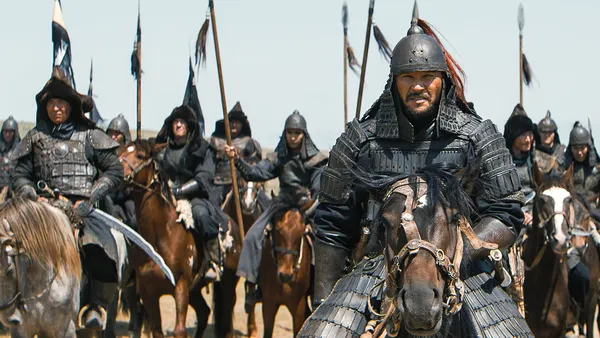
History aside (and you can take that much as a given here), there is a tradition in historical epics produced in the region of having a gifted male tactician depend on the women in his life for good advice on strategy. Jacob Schwarz’s epic nods to this tradition even where it subverts is. Schwarz, of course, is not a name local to the region; in this case its owner is an enthusiastic Californian with a love of war movies and period pieces. In the Californian tradition, he plays fast and loose with the facts, except where it comes to the combat scenes, which are brilliantly staged and also attentive to detail.

This film opens in 1363, 136 years after the death of the legendary Genghis Khan, when the great grasslands of Central Eurasia were divided between warring clans, a state of affairs which severely impacted trade and led to poverty all round. When his wife’s grandfather is assassinated, the situation deteriorates still further, forcing him to part from his family in order to try to clear the name of his clan. A series of adventures ensues, during which he obtains the injuries that famously left him with a limp (he is still known in the West as ‘Tamerlane’, a corruption of a Persian term for ‘Timur the lame’). He is betrayed, poisoned, and survives only due to the curiosity of strangers, whilst his beloved home city, Samarkand (beautifully depicted here) falls into the hands of enemies.
The latter half of the film is essentially focused on revenge, as Timur’s skill with military tactics, and with straight-out bluffs, begins to reveal itself. Scenes in which he trains with a Scot (large and ginger, of course) who has fought with William Wallace serves to slot the film into a timeline Western viewers will understand, and lets Schwarz demonstrate how much fun he can get out of a one-on-one skirmish even when we know nobody’s going to be killed. Timur still sees himself as an ordinary guy, resisting the constant urging of his friend Hussayn (Mahesh Jadu) for him to abandon his loyalties and lead his people in the spirit of an ancient prophecy. He has visions, however, and the image of a burning sword at the start of the film is a strong hint even to those who do not know that he would go on the be known as the Sword of Islam.
Perhaps that is a bit too delicately out. To be clear, he would go on to declare himself the Sword of Islam, and even in his early days, it’s well known that he was loudly ambitious. The Timur we see here has a completely different personality to go with his different face (we know what he actually looked like because colonial types later dug up his corpse) and different ethics (here his famous brutality has been replaced by a determination to see as few people killed as possible). In life he identified as a Mongol, seeking to restore Genghis’ empire; here he fights against the Mongols, describing himself in a completely different way. It is... a lot. On the plus side, even if you know the history well, the story will surprise you.
Then there are those battles. The whole film is gorgeously shot. The costuming, though not always accurate, is pretty close, and looks great whilst allowing the performers ease of movement. The military tech has been lovingly recreated, and it’s thrilling to see Chinese fire poles in action. We also see something of the athleticism still in use on the field in the early days of black powder. In one scene, warriors leap up to the height of men on horseback to slice through the front line of a cavalry charge, creating chaos for those behind it. The horses may not look quite right but they’re well trained, which is vital for this setting, and their confident manoeuvres add considerably to the overall effectiveness of military set pieces. Yet although he is keen to show us the moves involved, Schwarz keeps these scenes feeling rough and unpredictable, properly conveying both the thrill and the horror of combat.
In life, Timur was a fan of great chess, a game which really tests tactical skill. Here we see great chess pieces used to play a more mundane game. At least they look beautiful.
Reviewed on: 27 Jun 2026


Director: Jacob Schwarz
Writer: Matthew Greene, Christian Mortensen, Jacob Schwarz
Starring: Christian Mortensen, Mahesh Jadu, Yulduz Rajabova, Joshua Jo, Dulguun Odkhuu, Sanjar Madi, Arazou, Paul Marlen, Umit Ulgen
Year: 2026
Runtime: 119 minutes
Country: Uzbekistan, US, Kazakhstan
Festivals:
Search database:
